
Artificial Intelligence is a tool used by many and is seen in spaces all around us. Whether it’s in a video you’re watching, an article you’re reading or an educational space you exist in, AI is always observed.
It’s a nebulous term that encompasses a plethora of systems, yet so integrated into everyday life. Everyone you speak to has their own worries or optimistic views on the topic and it’s hard to understand how your life and the lives of those shaping the generations to come will be affected.
In general, AI has become a very viral topic with many questioning its ethicality, environmental impact, and social impact. Despite the dialogue, many people have a fundamental misunderstanding of AI and how it functions, including the different types of AI, how AI can be used and how that can affect the workplace or your education.
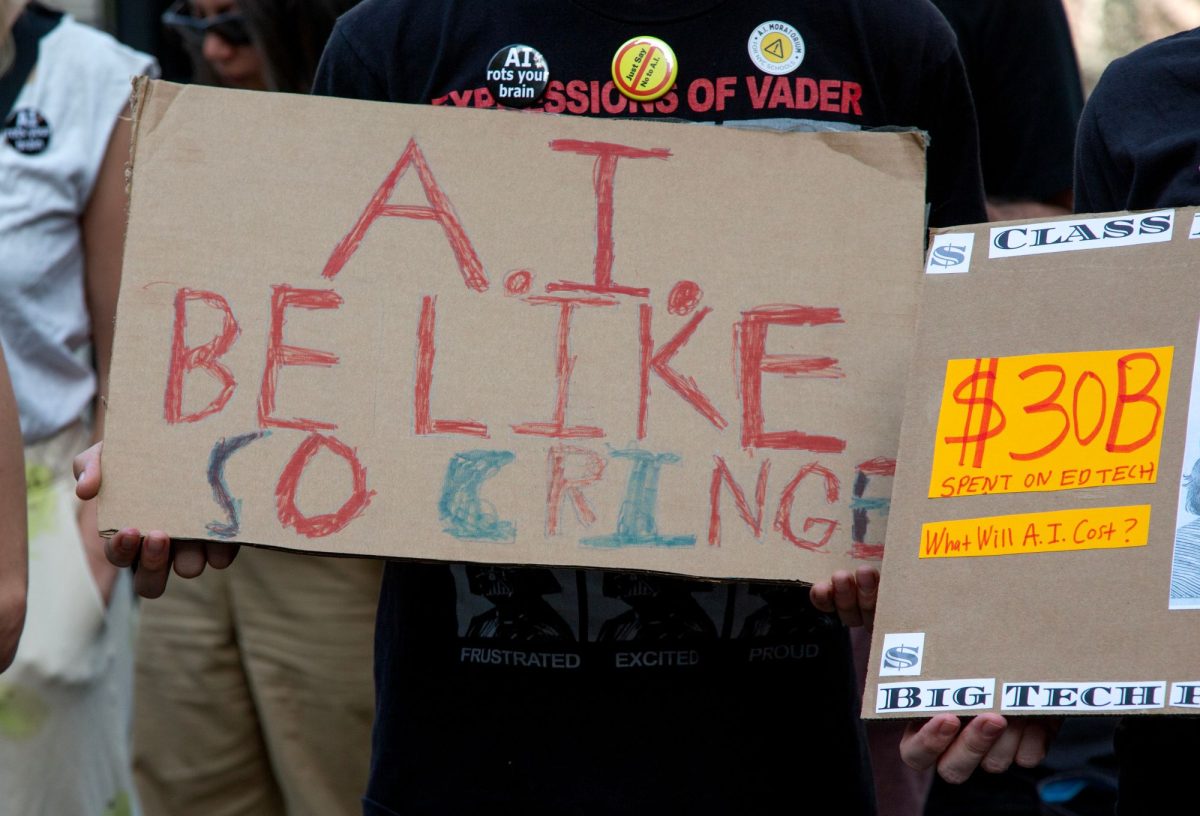
AI in education is a very controversial topic, with many straying away from it completely, some embracing it, and a few having a comfortable middle ground with the topic.
This controversy is caused by apprehension to allow new technology to be used in close proximity to children and students.
“What freaks me out is the idea that people are considering allowing it to be used on children before they know if it’s a good technology to have in schools,” said John Downes-Angus, an English Teacher at Baruch College Campus High School..
The general public does not have a very deep understanding of how AI functions, which is completely reasonable. It is a new technology that functions in a way that many people can’t completely wrap their heads around.
Most people don’t have the time or motivation to inform themselves on a topic that may not directly affect them.
When asked for his scope of knowledge, Downes-Angus said it was very limited. “I don’t know anything. I know that it’s like a really powerful search engine that can produce answers to basically anything,” said Downes-Angus.
This level of understanding is expected for new technology, but can be harmful when discussing its impact on education.
As of now, AI has an unofficial role in many schools, with some teachers using or attempting to use it for lesson plans or scheduling, and many students using it to aid them in their work outside of school.
In response to a question about English classes and AI, Alexander Castronovo, a Florida High School student, said “You should be able to write strongly using the tools that you would have available to you in the real world. So maybe for revision, right? But it should be your own ideas and you should be able to come out of the course as a stronger writer.”
Currently, AI is not being used in a regulated or formal way, as there are no visible guardrails in place to prevent or limit its use.
“I think with any tool we’re going to learn how to use it appropriately, right? Like with the calculator, for example – a big cheating tool, and then it turns out to be this really useful thing. You just need to learn how to use it,” said Castronovo.
Extensive research has been done by multiple institutions, including the College of Illinois, to measure its effect in education, but the long-term effects on students is not something yet available to research due to the recent nature of the technology, which raises concerns for many teachers and parents. Despite this, improvements are absolutely possible to improve the ethicality of its use along with the responsibility of those who use it in an academic setting.
Adaptation is what is most needed when working with new technology, as AI could aid in efficient scheduling for teachers and students, or summarize information for absent students to get caught up quickly.
Despite apprehension from many people, the reality is that new technologies never fade and the world, along with teachers, students and schools, will need to adapt to its use.