


The origins of Valentine’s Day are mysterious, but over millennia (and thanks to Hallmark’s marketing) it has become an important holiday all over the world—and with all holidays come specific traditions. Every February 14th, students exchange candy at school, couples share heart-shaped boxes of chocolate or a rose is given to the special someone you hold dear in your heart. These are just a few examples of the many practices associated with Valentine’s Day.
For a little bit of background, Valentine’s Day is said to have started in Rome in order to “Christianize” a pagan celebration already being practiced called Lupercalia. Lupercalia was a festival meant to bring fertility in the coming year and it was celebrated on February 15th each year. But while Valentine’s Day is known today as a celebration of love, Lupercalia involved ritual sacrifices and was somewhat dark.
It’s often said that Saint Valentine is key to the origins of Valentine’s Day since it has his namesake, but what you may not know is that there were three Saint Valentines who the holiday could get its title from. Even so, Saint Valentine is typically known for his charity and all three of the Valentines died martyrs. Saint Valentine is also given credit for creating the phrase “From your Valentine,” which he used to sign a letter for a woman he befriended.
In different parts of the world, Valentine’s Day is celebrated in different ways. In Denmark, people take a humorous approach on the holiday and write jokes on the petals of white snowdrop flowers, meant to show the coming of spring, to exchange with each other. In Guatemala, a huge parade on El Día del Cariño, meaning the day of affection, is about both romantic and platonic love.
Finally, in both Japan and South Korea, women give “honmei choco,” or favorite chocolate, to their loved ones. Men give a white themed gift back to them on March 14th, known as “White Day.” And of course South Korea doesn’t forget the singles, because on April 14th, “Black Day” is celebrated for those who didn’t receive a gift on Valentine’s or White Day to meet with their friends wearing black clothing, drinking black coffee and eating “jajangmyeon” (noodles with black bean sauce) together.
In the United States, Valentine’s Day became popular in the 1840s as a holiday oriented toward romantic love. Valentine’s Day stationery started gaining steam in the 1850s and only expanded from there as more Americans caught on to the trend. Hallmark became popular for making Valentine’s Day inclusive for all kinds of love, not just romantic. To this day, stationery brands help people express their love for others when they can’t find the words themselves. In the 1950s, Candy Grams were introduced in schools as a way to fundraise and let kids have a little sweet treat. Some schools sell roses instead, and many have a Valentine’s dance (like at Baruch) to celebrate the occasion with students.
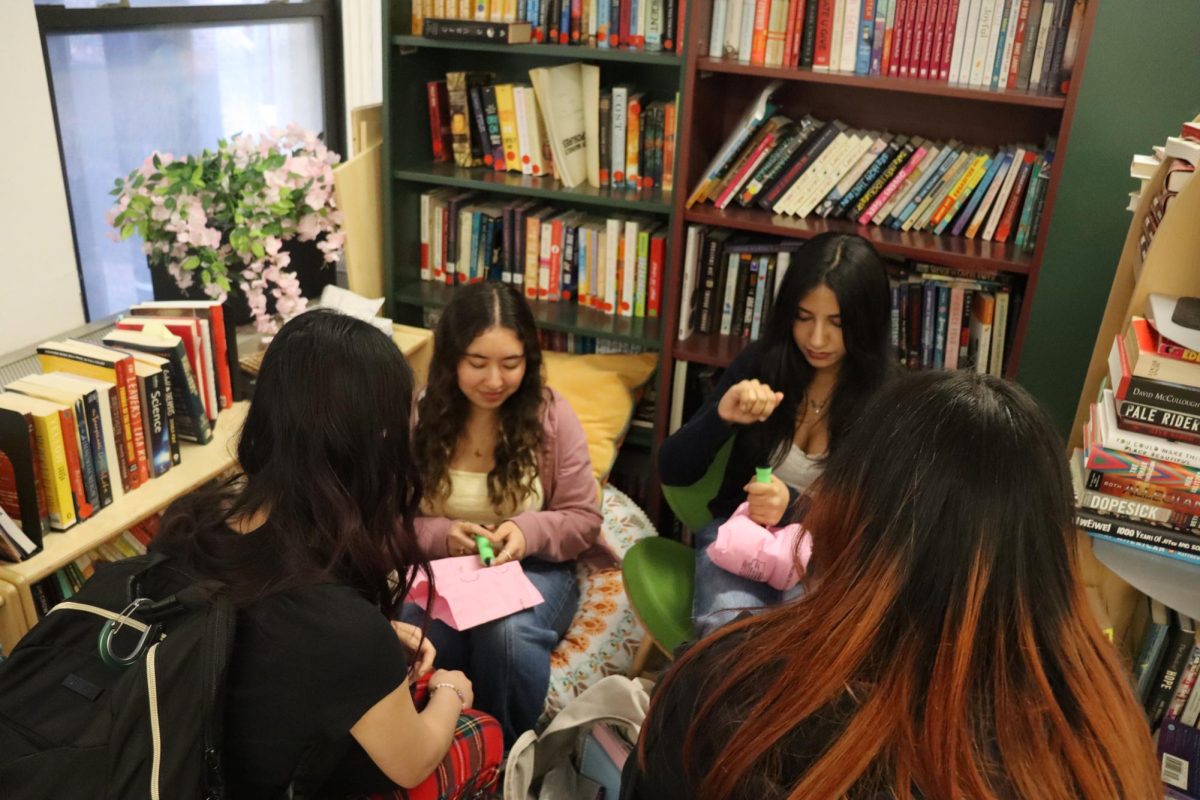
One of the more modern ways of celebrating Valentine’s Day is “Galentine’s Day,” which is where female friends get together to celebrate in each other’s company. As opposed to being celebrated on the 14th of February, though, it’s celebrated on February 13th. Interestingly enough, Galentine’s Day started as a fake holiday in the sit-com “Parks and Recreation,” but is now a special way to celebrate female friendships.
Alveena Khan, a freshman, has celebrated Galentine’s Day with her friends and cousins, a tradition that she recalls fondly. “One thing I love about it is that I get to hang out with all my friends. We get to spend time with each other and just have fun in general,” she said.
As Valentine’s Day comes up, we encourage you to recognize all the people you love in your life. Make your own traditions that show how much you appreciate them, and who knows? Maybe it’ll become a widely marketed practice for years to come!











Andrea • Feb 11, 2026 at 3:01 pm
Wow I really wanted to spend Valentines with my kids and the photo of the craft reminded me of when they were younger! Thank you for reminding me of that joy