Sometimes words are better sung than spoken.
When injustice becomes too much, melodies can help send a powerful message. From whispered religious hymns to modern anthems, music has continued to spark change and empowerment within Black communities.
Spiritual Songs
One of the few ways that enslaved people were able to express themselves was through song—hymns, to be exact, which were songs of worship. These melodies referenced the Bible with hopes of freedom. Some songs even contained instructions for escape such as Wade in the Water and Swing Low, Sweet Chariot.
Wade in the Water “If you don’t believe I’ve been redeemed, Just follow me down to Jordan’s stream.” Soft melodies like these were a quiet protest against slavery and offered emotional catharticism.
Civil Rights Movement
Lift Every Voice and Sing was originally a hymn written by NAACP leader James Weldon Johnson in the 1900s to celebrate President Lincoln’s birthday. However, it is now known as the Black National Anthem of resilience.
Angered and frustrated by the injustice, coded hymns were slowly replaced by more direct, vocalized protest. Billie Holiday’s Strange Fruit was first written as a poem Bitter Fruit in response to the brutal lynching of Black Americans. The blunt and heartbreaking lyrics like “Scent of magnolias, sweet and fresh, Then the sudden smell of burning flesh” forced listeners to confront white supremacy and violence.
Despite numerous warnings from the government to stop performing Strange Fruit, Holiday continued to sing the song. It soon became a crucial song played at protests during the Civil Rights Movement.
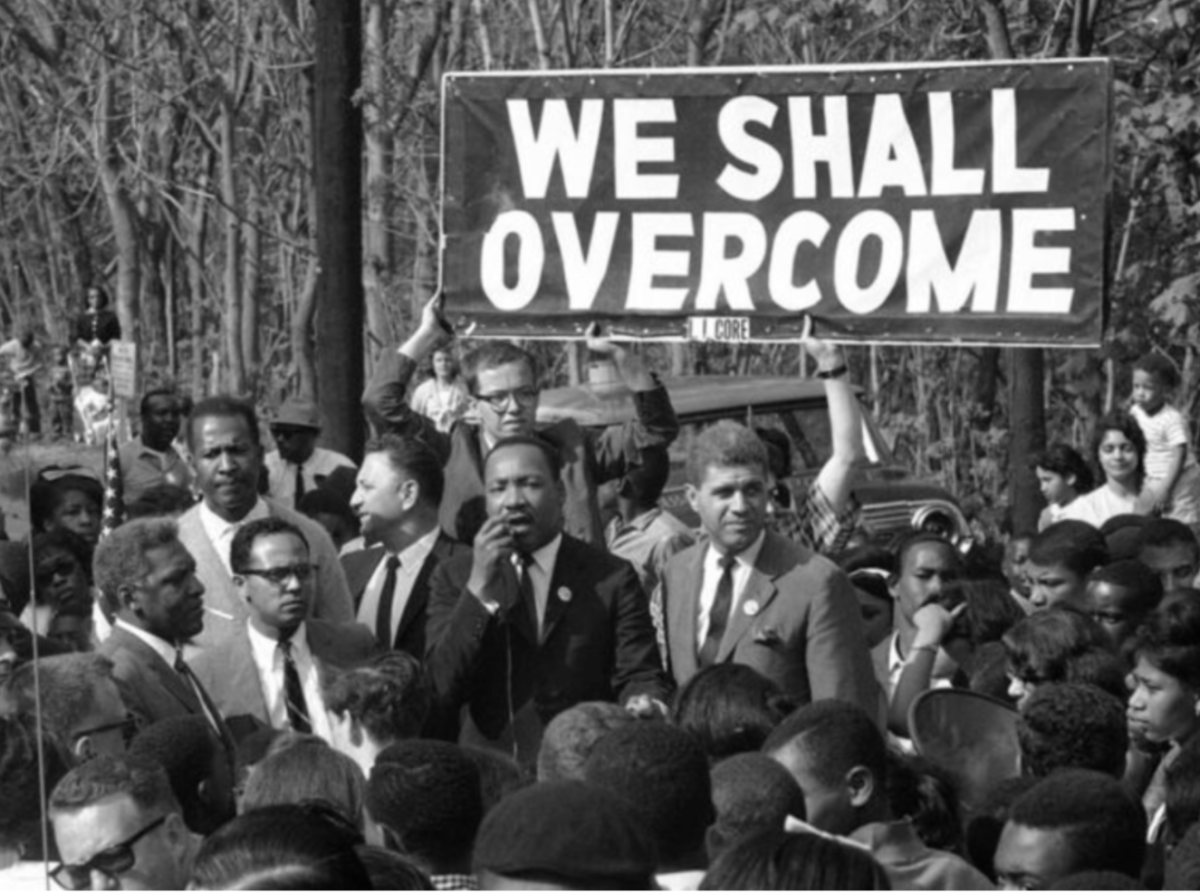
During the Civil Rights Movement, music was a force to build morale, unity, and courage during peaceful marches. Songs blended African American spiritual songs, gospel and folk such as We Shall Overcome, Mississippi Goddam by Nina Simone, and People Get Ready by The Impressions, and This Little Light of Mine.
We Shall Overcome was originally a gospel hymn from the 1900s I’ll Overcome Someday and popularized by singers like Pete Seeger. Although Seeger is credited with the lyric change, the protest song became popular at a 1945 strike against the American Tobacco Company in South Carolina. Lucille Simmons, one of the workers on strike, changed the lyrics from “I’ll overcome” to “We will overcome.”
Seeger did however, notably change the lyric further to “We shall overcome” and even added new unifying lyrics such as “We’ll walk hand in hand.” Nonetheless, Seeger performed the song for Dr. Martin Luther King Jr. in 1957 and it soon gained popularity to become the unofficial anthem of the movement.
In contrast, other songs during this time contained more sharp lyrics with jazz and blues influence such as Mississippi Goddam by Nina Simone which she wrote after the devastating bombing of the 16th St Baptist Church and assassination of civil rights activist Medgar Evers. Simone uses a call-and-response technique with her band as a parallel to the slow progression of civil rights. After singing “Too slow!”, the backing band responds “Do it slow.” The song was banned in multiple Southern states, but now it is recognized as a cornerstone protest song.
That same year, Sam Cooke released another soulful anthem called A Change Is Gonna Come in which he sings, “It’s been a long time coming, but I know A change gon’ come.”
For the most part, songs were written at this time to spread hope for a better future where equality was the norm instead of a right that needed to be won.
Soul, Funk & Rock
After the assassination of Civil Rights activist Martin Luther King Jr., protest songs shifted from songs of hope and unity to themes of disillusionment and black empowerment. Despite civil rights being granted on paper, racism and inequality still prevailed. Protest songs were understandably angrier, and grew to be more directly critical of society’s normalized racism, similar to Simone’s Mississippi Goddam.
Disillusioned by the seemingly hopeless peaceful protests that had been conducted, Black artists responded to the violence with rock and funk anthems. Say It Loud—I’m Black and I’m Proud became a cultural sensation with its unapologetic demand for respect—removing stigma around the term “Black” and thus, embolden Black people to take pride in their identity.
Modern Era: Hip-Hop & Rap
Currently, hip-hop and rap are used to deliver raw lyrics to address specific issues like systematic racism and police brutality. Despite continued resistance, the fight for equality is ongoing. However, social media has helped spread awareness rapidly, changing the way that music is shared and listened to.
Rap gives artists a platform to express everyday struggles including Fight the Power by Public Enemy and Changes by 2Pac. Kendrick Lamar’s Be Alright, H.E.R. ‘s I Can’t Breathe, and The Bigger Picture by Lil Baby became powerful anthems for the Black Lives Matter movement. No matter the time period, specific issue, or genre, all protest songs share the same sentiment: the desire for change. Music has a way of bridging barriers, bringing people together to fight for a common goal. For now, let us Lift Every Voice and Sing.