The NFL Superbowl Halftime Show is a yearly event NFL fans and Americans look forward to. It’s a complete spectacle but when Bad Bunny was announced to headline the show, it became a cultural statement that highlighted Puerto Rican History and the Hispanic identity as a call for American unity.
Sugar Cane Plantations
In the opening scenes of the halftime show, the audience is transported to sugar cane fields, a direct reference to Puerto Rico’s past. Sugar cane was an economic engine for many countries in the Caribbean in the 19th and early 20th century. Sugar cane agriculture became a major industry after the United States gained control of Puerto Rico in 1898. These scenes honored the agricultural workers, showed the symbolism of colonialism and slavery and how those events shaped Puerto Rico’s economy and history.
Transition to Modern Puerto Rican Life
The scenes then shift from past to present showing modern Puerto Rican life. The field is filled with depictions
of Hispanic culture: food stands, bodegas, older men playing dominos, women getting their nails done, all together recreating latin communities. They display common Puerto Rican culture: Piragua stands, Coco Frio, boxing—connecting back to his roots.
As a Latina, having these visuals being shown to the world brings down typical stereotypes that don’t represent the actual culture of our people. Seeing this depiction of hispanic culture, it reminded me of Queens, The Heights and East Harlem where these areas are filled with hispanic and latin communities that feel pride over where they’re from. This part of the performance celebrated life, not something political but something lived daily across many communities.
El Sapo Concho
In the stadium, the screen showed El Sapo Concho, a native toad to Puerto Rico and a symbol of Puerto Rican identity and resilience. El Concho is an endangered toad found only on the island after many believed it was extinct for over 4 decades until the 1970s. He’s known as Concho in the “Debi Tirar Mas Fotos” album by Bad Bunny. It embodied the destruction of Puerto Rican life due to colonialism and gentrification.
The Wedding Celebration
The show then transitioned to a live wedding scene where an actual couple, Eleisa Aparicio and Thomas Wolter, two nurses from Southern California were married on stage. The couple had invited Bad Bunny to their wedding and instead, he invited them to get married at the show and have him as their witness! This wedding represented your traditional Hispanic celebration filled with music, guests dancing salsa and it symbolized a universal experience in hispanic culture. The wedding symbolized unity, not only between the couple, but between the family and generations!
During the celebration, many felt nostalgic at seeing the different moments where kids were running, families dancing, but it felt like a moment of all our lives were missing until it was actually represented in the show. A nostalgic memory was brought back to many generations: a child was shown sleeping on a chair while the party continued around them. Every Hispanic kid has done that before, it’s a universal experience!
Lathan Chen, an 11th grader at our school expressed how even though he is Indonesian, he still experienced this moment in his own culture. “I thought the most relatable moment for me was seeing a child sleep on plastic chairs. It is a classic family tradition even in my own culture,” he said.
Ashley Carvajal, an 11th grade student also expressed her familiarity with this moment. “There were a lot of cultural references that connected to my own culture and what I’ve seen growing up. Bad Bunny showed him waking up a sleeping kid on the chairs and this comedic act is something I’ve seen all throughout Hispanic parties. I feel like this is definitely one of the touches that make a difference because they’re so small, yet you notice if it wasn’t there,” Carvajal said.
Lady Gaga’s Performance
During the wedding, Lady Gaga appeared on stage as one of the 2 artists Bad Bunny invited into the show. In this moment she wasn’t only a recognized American pop artist, she symbolized something greater. She joined the celebration by performing a salsa version of her song “Die With A Smile”. Lady Gaga’s presence symbolized cultural openness and inclusion.
Isabel Duque, an 11th grader at our school expressed her thoughts of this part of the halftime show. “I think it was trying to portray all the fun that Hispanic culture is and kind of invite people in. Especially when Lady Gaga was singing salsa, it felt like the Latin culture is for everybody,” Duque said.
Lady Gaga’s outfit also carried symbolism tied to Puerto Rico. Gaga wore a custom made light blue dress designed by Raul Lopez of the Brooklyn based fashion label Luar. The light blue color of the dress referenced the light-blue that used to be in Puerto Rico’s flag before 1952 when the government adopted the pro-independence flag as Puerto Rico’s official flag but changed the sky blue to navy blue so that it matched the United States Flag. Another symbolic design of the dress was its red accents and a flor de maga – which is Puerto Rico’s national flower!
NuevaYol and Puerto Rican Diaspora
As Bad Bunny’s hit song “NuevaYol” started playing, the performance highlighted the Puerto Rican diaspora in New York City and the vast communities that formed there over the years. As Puerto Ricans moved into NYC, they continued to preserve their traditions and culture. For many, these new cities became their home and connected their identities both from Puerto Rico and in communities across the US.
During this scene, Toñita Cay, owner of Brooklyn’s Caribbean Social Club made an appearance on stage while serving Bad Bunny a drink from a set piece designed to resemble a small bar that’s surrounded by other set designs of typical hispanic shops. Toñita has run the Caribbean Social Club in Brooklyn for more than 50 years and has refused to sell the property despite the gentrification in that area. The club is one of the last Puerto Rican social clubs in New York City and has served as a place where people from their communities share their love for music, food and traditions!
Not only that but Bad Bunny made a brief musical tribute to Willie Colon, a legendary Puerto Rican Salsa musician who helped shape Latin music in NYC during the rise of Salsa in the 70s. A small portion of one of Colon’s songs played during the show, honoring his influence on Puerto Ricans over generations. Bad Bunny honored the many Puerto Rican generations of immigrants who built communities in cities like New York who still stayed connected to their roots!
Future Generations
Another symbolic moment occurred when Bad Bunny handed his Grammy Award to a young kid on stage. During this scene, the boy watched Bad Bunny on television where he accepted his first Grammy award. The gesture of handing the young boy his trophy symbolized hope and encouragement to younger generations to follow their dreams and believe in themselves.
Rick Martin’s Performance
While many people expected artists such as J Balvin or Cardi B to perform at the Halftime show, a beloved Puerto Rican singer appeared on all our screens, Ricky Martin. He performed Bad Bunny’s song “Lo Que Paso A Hawaii”, a song that draws parallels between displacement, gentrification and cultural loss experienced in Hawaii after the US annexation and the similar feelings/fears about Puerto Rico. Ricky Martin’s presence itself while singing in his native language spread a message about identity and resistance. This scene moved many people watching and connected to the hearts of many as they felt seen and represented, not only Puerto Ricans but Hawaiians and other nationalities that have been colonized by stronger nations.
El Apagon
Near the end of the show, Bad Bunny performed “El Apagon” while standing on top of an electric pole with
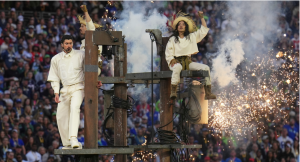
other dancers climbing the surrounding poles across the stage. This visual referenced the frequent power outages in Puerto Rico highlighting the country’s ongoing infrastructure challenges.
This moment symbolized more than electric issues, it represented the resilience and self reliance Puerto Ricans have had to adapt to due to the neglect they face from the US government. As the dancers represented Puerto Ricans attempting to fix the electricity, it reflected how the communities often had to take matters into their own hands due to the neglect they faced.
Angy Angamarca, an 11th grade student shared her views on this moment. “This symbolizes the ongoing power outages that Puerto Rico faces due to the many natural disasters that occur. As well as explained how the government and the US neglect these issues that are occurring in the island… This shows a representation of how many people of the island attempt to fix these problems on their own. As they are disregarded by the government,” she said.
Bad Bunny uses his music to highlight the resistance, strength and community perseverance making this scene one of the most political parts of the halftime show.
Flags of the Americas
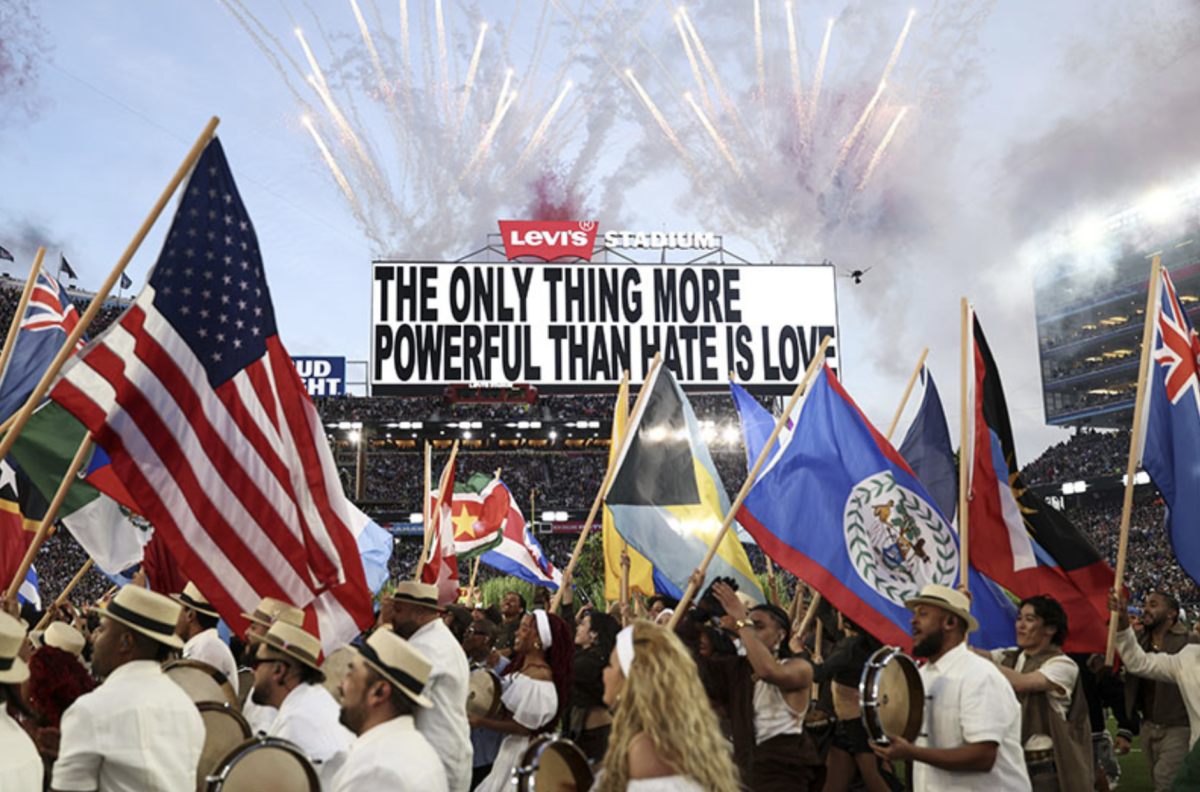
FAs we viewed our screens, multiple flags waved across the stadium representing countries across North, Central and South America, emphasizing that “America” isn’t only the United States but the entire western hemisphere and its diverse nations.
“God bless América, sea Chile, Argentina, Uruguay, Paraguay, Bolivia, Perú, Ecuador, Brasil, Colombia, Venezuela, Guyana, Panamá, Costa Rica, Nicaragua, Honduras, El Salvador, Guatemala, México, Cuba, República Dominicana, Jamaica, Haiti, United States, Canadá, My land, mi patria, Puerto Rico, Seguimos aquí,” said Bad Bunny.
Katie Caba, an 11th grader, felt like this was important to represent in the halftime show because it reminded everyone how we are all Americans. “He waved all of the different flags in America, North, South and Central America. It’s just embracing all different cultures in America. Not just the United States or Hispanic countries. I think the performance was trying to send a message to send love and not hate. He wants everybody to be united and feel like they have a place in the world,” she said.
He tied all of the themes of the show together: family, resilience, cultural pride, diaspora, love and reminding the audience that the Americas are united. “Together We Are America.”
Reactions to the Halftime Show
When it was made known to the public that Bad Bunny would be headlining the halftime show, it sparked
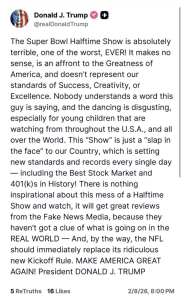
intense reactions online. Many claimed his music or cultural focus was an inappropriate choice for this “American” event. Many questioned whether he was a suitable representation for the halftime show due to his style of music and the themes he presents. Others emphasized how Bad Bunny’s emphasis on social issues was too political which resulted in backlash and threats.
Public figures, including President Donald Trump, Piers Morgan and Megyn Kelly as well as many other Americans criticized the performance. In addition, Turning Point USA created a separate halftime show where it featured performers such as Kid Rock, Brantley Gilbert, Gabby Barrett, Lee Brice as well as led by Erika Kirk where it aired during the main halftime show. This alternative show was widely seen as an attempt to disrespect Bad Bunny’s performance and the messages he was promoting about Hispanic identity as well as disrespect to the Hispanic communities being represented amidst the national chaos we witness everyday.
Despite the backlash and threats received, supporters argued back saying that Bad Bunny’s performance was amazing, successfully celebrating what Hispanic culture and identity actually is: communities full of love, strength, resilience and overall, unity.