
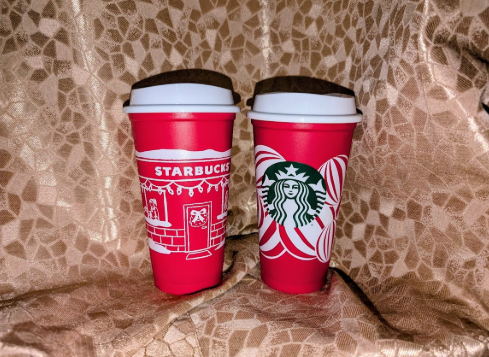
On November 13, 2025, Starbucks hosted its annual Red Cup Day, in which customers could receive a free reusable plastic red cup with the purchase of a handcrafted holiday or fall beverage. However, this year was no ordinary Red Cup Day, as many Starbucks workers sparked an Unfair Labor Practice (ULP) strike, calling for the company to offer workers a fair union contract.
A similar line of demonstrations occurred in December 2024 when the company failed to finalize a contract amidst negotiations. This time around, Starbucks Workers United (SWU) is demanding an immediate 65% pay increase, a 77% pay increase over the next three years, along with higher pay for weekends, early and late hours, sorting inventory and working on busy promotion days such as Red Cup Day. A full list of demands, background information about progress towards a fair contract, and Starbucks’ past offenses can be found in a memo published by SWU.
The spokesperson of SWU, Michelle Eisen, said in an interview with ABC News, “What we need is for this company to invest in the workers that open and close these shops every day, who are the face of the company that brings in these billions of dollars that they report every year in revenue. We’re looking for the company to return to the table with new proposals that solve these issues, and we’re looking for them to stop their egregious union busting.”
In fact, according to an analysis from the Strategic Organizing Center, Starbucks has spent $240 million on union-busting efforts. The company’s attempts to suppress these efforts include trying to defeat a pro-worker insurgent campaign for seats on the Board of Directors, firing pro-union workers and closing profitable locations where support for a union had been established.
Despite Starbucks’ persistent attempts, many baristas feel confident that, alongside public support, they will succeed in garnering sufficient attention that will bring them closer to their goals.
Isabel Gonzalez, a 3-year barista from California, told SWU, “As the holiday season ramps up, our movement is growing in power. For every one barista on strike, dozens more allies have shown up in force to back our cause.” These allies have prominently demonstrated their support by boycotting Starbucks and attending and organizing protests.
Indeed, many students at Baruch have expressed their support for employees. 12th grader Casey Badolado, who occasionally orders a flat white, said, “I think that consumers should either boycott the company until they are given fair hours, or fairly tip employees if they’re not making enough of a livable wage.”
When asked if she had ever boycotted Starbucks, Badolado said, “Yes, when my friend had personal opinions about it, I didn’t go at all for about a year or two.”
For other students, these strikes hit closer to home.12th grader Brissia Sanchez, who sometimes enjoys a chai latte, said, “I know about them because my brother works there. From what I know, I’m pretty sure he will be affected because some of the stores have been closing. It’s becoming a real problem for workers.”
When asked about her opinions of the demands, Sanchez said, “ I understand them wanting higher wages for the job they’re doing. I know, it’s really difficult, and since we live in NYC, the demand for Starbucks is higher.
Politicians can also be instrumental in implementing changes by enforcing them at the legal level. A barista, Silvia Baldwin, from Philadelphia, told SWU, “Organizations representing over 85 million people have backed our demands. Elected leaders–from moderates to progressive firebrands to newly elected democratic socialists–are standing with us.”
Under the Fair Workweek Law, fast food employers in NYC are required to provide workers with regular schedules, premium pay for changes in schedules, the opportunity to decline to work extra time, and the opportunity to work newly available shifts before additional workers are hired. According to Al Jareeza, NYC’s Department of Consumer and Worker Protection (DCWP) has claimed that since 2021, Starbucks has committed more than half a million violations of this law.
Previous NYC mayor Eric Adams and current mayor Zohran Mamdani have both placed public pressure on Starbucks to meet union demands. In December 2025, Adams announced a $38.9 million settlement to restitute more than 15,000 workers who had been affected by Starbucks’ violations of the Fair Workweek Law. This has been celebrated as a momentous settlement in the history of NYC.
As one 12th grader, Elizabeth Yung, said, “I feel like a lot of it has to do with people just trying to help raise awareness about this issue.”


Samuel • Jan 16, 2026 at 12:05 pm
This article really frazzled me especially as a frequent Starbucks drinker. Really good job and interesting thank you I now know more and I’m aware of the cost.